


Free Employment Contract Templates Come With Hidden Costs


Every now and then, a business owner tell us the same thing: "We have contracts in place." And they are right; they do have something. A document that looks like a contract. One they found on Google, downloaded in under two minutes, and had their employee sign before the first day of work.
The problem is not that they have paperwork. The problem is what happens when that paperwork is tested. Labour disputes are on the rise globally. Employees are better informed about their rights. When a case lands at the Labour Commission or in court, your employment documentation is placed under a microscope. A missing termination clause may mean the dismissal procedure is challenged. An unclear employment classification may mean an employee claims permanent status, and the benefits that come with it. A vague confidentiality clause may mean the court sets it aside entirely. What your contract left out may end up deciding what you owe.
What "generic" really means
When we say a template is generic, we do not mean it looks unprofessional. Many free templates are well-formatted and cover the basics: job title, salary, start date, notice period. What they do not cover (and cannot cover) is the specific legal framework of the country your business operates in.
Ghana's Labour Act 651 for instance, sets out precise requirements for how employment relationships must be structured, documented, and ended. A template written for the United Kingdom, South Africa, or no particular country at all does not reflect these requirements. It may look complete. But legally, it has gaps. Those gaps are where liability lives.
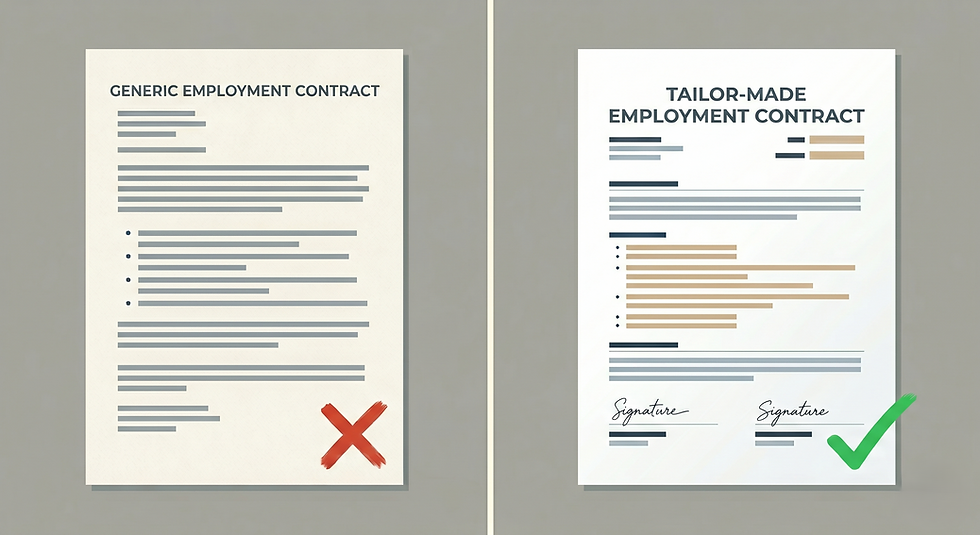
Three ways generic employment contract templates expose businesses to liability
1. Missing jurisdiction-specific clauses
Ghana's Labour Act 651, for instance, requires that certain terms be stated clearly in writing (including the nature of employment, entitlements, and the procedures for termination.) A generic template that does not reflect these requirements can leave an employer in breach of the Act before a single dispute has even arisen.
2. Casual worker arrangements treated as permanent employment
This is one of the most common and costly mistakes we see. The distinction between a casual worker and a permanent employee carries legal consequences. In a country like Ghana, permanent employees are entitled to terminal benefits, longer notice periods, and greater protection against unfair dismissal. Casual workers are engaged on different terms. When a contract is poorly worded, vague, or simply copied from a template that does not account for specific legal requirements, the results may be back-pay, terminal benefits, and damages that the employer never budgeted for.
3. Confidentiality agreements that do not hold up
Many business owners include NDA or confidentiality clauses in their employment contracts as a matter of course. What they do not always know is that a poorly drafted NDA is effectively unenforceable. If a clause is too broad, too vague, or not properly anchored in the terms of employment, a court can set it aside entirely. If a key employee walks away with your client list or proprietary information, an unenforceable NDA means you have no legal recourse. And the cost of finding that out is the litigation itself.

What a compliant employment contract actually covers
A template that has been reviewed by an HR and legal compliance professional is structurally different. Here is what it addresses that a generic template typically does not:
Jurisdiction-aligned language
Every clause is reviewed against labour laws and any other applicable legislation for your operating country. Nothing is borrowed from another jurisdiction.
Clear employment classification
The nature of the employment relationship (casual, fixed-term, or permanent) is defined precisely, with entitlements mapped correctly to each classification.
Termination and disciplinary procedure
The contract sets out a process that aligns with statutory requirements. This protects the employer on procedural grounds, even when the decision to terminate is entirely justified on the merits.
Enforceable confidentiality and IP protection
NDA and intellectual property clauses are drafted to be legally defensible, and not decorative. If you ever need to rely on them, you can.
The cost comparison that matters
A compliant, expert-reviewed employment contract is a one-time investment. The cost of a single labour dispute (even one you eventually win) includes legal fees, management time, lost productivity, and the distraction that comes with any formal proceeding.
We have seen straightforward unfair dismissal claims cost more to defend than an entire year of HR documentation would have cost to get right in the first place.
Getting it right before a dispute is not a luxury. For a growing business, it is risk management.

How OML Africa can help
Our Templates and Toolkits service takes the guesswork out of employment documentation. Backed by HR and legal compliance expertise, we develop contracts and agreements that are clear, compliant, and ready for real-world use, including casual worker agreements, fixed-term contracts, NDAs, and permanent employment contracts.
You tell us what you need. We review it against the applicable labour legislation, adapt it to your business context, and deliver a document you can use with confidence.
Ready to get your employment contracts right?
Or reach us directly at peopleservices@omlafrica.com | +233 302 973 379
OML Africa is a leading HR compliance consultancy operating across Ghana, West Africa, and Europe. We work with SMEs, corporates, NGOs, and international organisations to build people practices that are legally sound, commercially practical, and built to last.

Comments